 Aside from diabetic
retinopathy, there are several other distinct retinal diseases that are more
often associated with diabetes, though they certainly can occur in non-diabetes
patients as well.
Aside from diabetic
retinopathy, there are several other distinct retinal diseases that are more
often associated with diabetes, though they certainly can occur in non-diabetes
patients as well.Copied from http://www.diabetesincontrol.com/issue190/chous.shtml without permission as an archive copy in case the link vanishes from the web.
HYPERTENSIVE RETINOPATHY
Paul Chous, M.A., O.D. Doctor of Optometry
Type 1 diabetic since 1968
Aside from diabetic
retinopathy, there are several other distinct retinal diseases that are more
often associated with diabetes, though they certainly can occur in non-diabetes
patients as well.
Hypertensive retinopathy, damage to the retina from chronic and/or acutely elevated blood pressure, leads to abnormal narrowing and stiffening of the retinal arterioles, serum, lipid and protein leakage in addition to bleeding from retinal capillaries, and even swelling of the optic nerve. Vision is not usually affected unless the macula becomes involved or optic nerve swelling impairs the transmission of electrical signals to the brain. Because diabetes patients have a greater than average tendency for high blood pressure (twice the normal risk), their risk for hypertensive retinopathy is also greater.
Like arteries and veins throughout the body, retinal arteries carry blood from the heart and lungs to the retina, while retinal veins carry blood away from the retina back to the heart and lungs. Retinal blood vessels, arteries and veins, travel together throughout the retina and cross over one another as they deliver and remove blood. Because high blood pressure causes stiffening of the retinal arteries (just as a flimsy garden hose becomes stiffer, or more rigid, when the water pressure is increased), these arteries have a tendency to ‘crimp’ (push on, deform) the less rigid veins where the two cross over one another. This can cause a dramatic, localized narrowing of the vein that impairs (decreases) blood flow (Figure 12.1).
Figure 12.1
The Mechanics of Hypertensive Retinopathy and Vein Occlusion
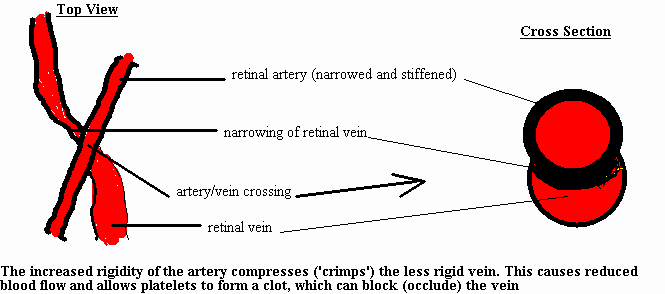
In addition, if platelets in the blood stream (cells responsible for normal clotting) clump together within this narrowed area of a retinal vein, a tendency which is increased by both slower blood flow and any increase in the adherence (‘stickiness’) of platelets, a "thrombus" (blood clot) forms which may completely block (occlude) the vein. Occlusion of a retinal vein results in substantial bleeding, swelling (retinal edema) and tissue damage. If a vein supplying the macula is affected, or if vitreous bleeding or edema affect the macula, at least some vision is lost. As with diabetic retinopathy, ischemia (lack of blood supply) to surrounding retinal tissue may occur, which can lead to profound vision loss, as well as the formation of new, abnormal blood vessels ("neovascularization") and neovascular glaucoma, both of which can cause blindness.
Because many diabetes patients tend to have stickier platelets, and because of a greater likelihood of high blood pressure, diabetes patients have a much higher than average risk of retinal vein occlusion (about 60% of patients who suffer retinal vein occlusion have diabetes, high blood pressure, or both.) However, the culprit in this form of ‘diabetic eye disease’ is not hyperglycemia per se (as with all the other eye diseases discussed in this section), but hypertension, possibly coupled with an abnormal clotting tendency. Visual impairment from retinal vein occlusion ranges from none to severe, depending upon which vein is blocked (the ‘central’ vein supplying the entire retina versus one of the smaller ‘branch’ veins supplying only a portion of the retina), to what extent the macula is involved, and the development of complications like retinal neovascularization and neovascular glaucoma (these often take several months to develop).
It is extremely important that all diabetics understand a fundamental distinction between good eyesight and good eye health. The ability to see clearly (on an eye chart test or in the real world) is not equivalent to having healthy eyes. Many patients with serious eye disease have excellent eyesight, and the vast majority of patients who require eyeglasses or contact lenses to see clearly have healthy eyes. Just as for many patients with heart disease or cancer, patients with eye disease often have no symptoms until it is "too late." Regular, comprehensive eye examinations by an eye care professional (optometrist or ophthalmologist) are the best way to ensure both good eyesight and good eye health.
 Lessons from a Diabetic
Eye Doctor: How to Avoid Blindness and Get Great Eye Care
Lessons from a Diabetic
Eye Doctor: How to Avoid Blindness and Get Great Eye Care
Book Description
Diabetes affects every part of the eye, not just the retina. Presenting critical
information about seven different kinds of diabetic eye disease as well as
important steps all diabetics must take to preserve vision, Dr. Chous clearly
and comprehensively guides you through the fundamentals of good diabetes
management and great eye care. Written by an eye doctor, diabetes educator and
patient advocate, this book is dedicated to helping you or someone you love
avoid blindness and other complications by taking charge of your diabetes.
Paul Chous, M.A., O.D. Doctor of Optometry, Type 1 diabetic since 1968
